
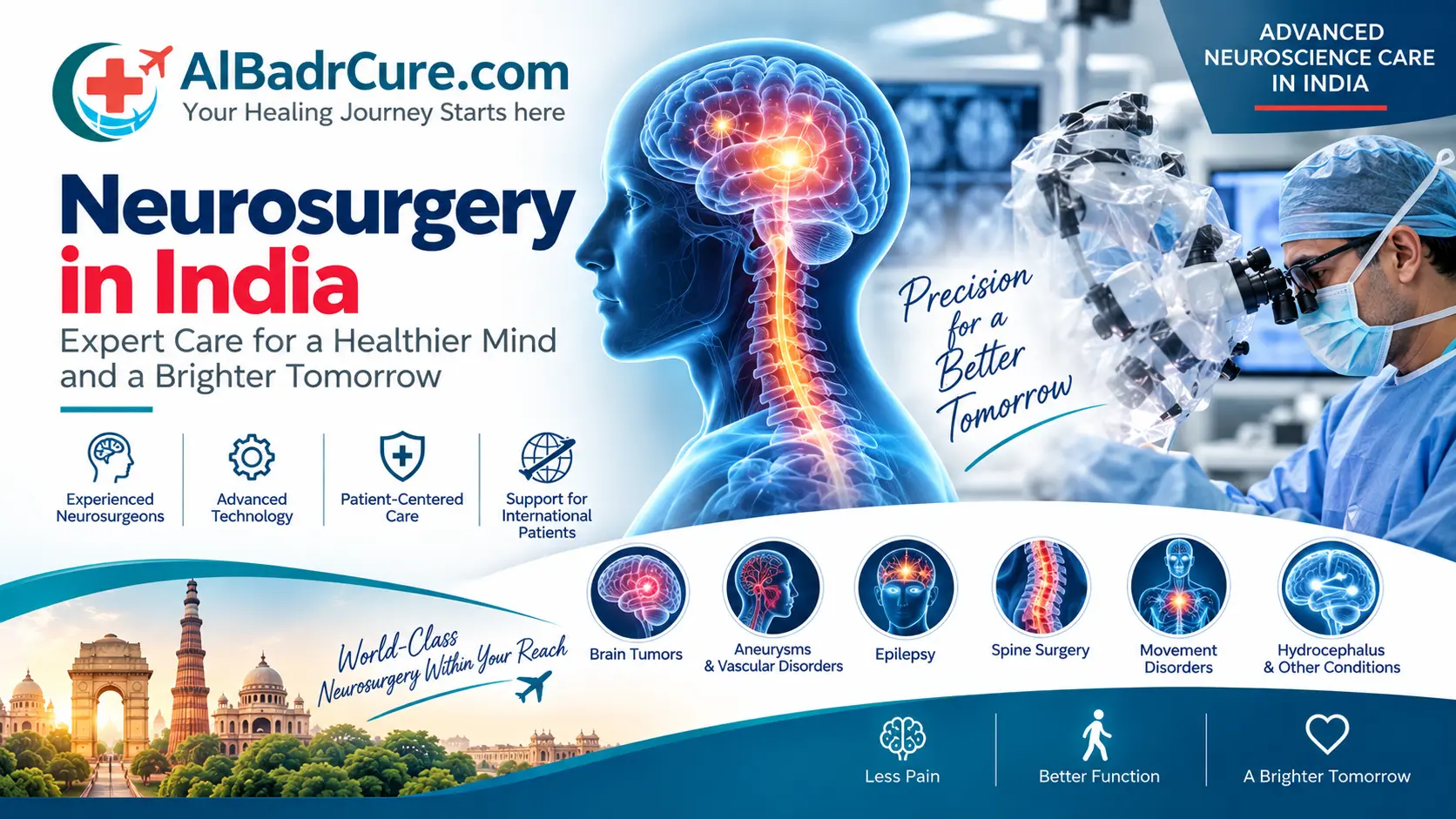
Neurosurgery is a highly specialised medical field focused on the surgical diagnosis and treatment of disorders affecting the brain, spinal cord, nerves, and supporting structures. Modern neurosurgery combines microsurgical techniques with advanced imaging, neuronavigation, endoscopy, stereotactic systems, and intraoperative monitoring to help surgeons reach complex anatomical areas with greater precision.
India has developed specialised neuroscience centres offering treatment for brain tumours, aneurysms, hydrocephalus, epilepsy, movement disorders, traumatic brain injuries, spinal conditions, and other complex neurological disorders. Major centres such as AIIMS and leading private hospitals provide dedicated neurosurgical operating theatres, intensive care, neuroimaging, and subspecialty services.
Treatment Type: Surgical / Minimally Invasive / Endovascular
Hospital Stay: Same day to several days or longer, depending on the procedure
Recovery: Varies from several weeks to months depending on the condition and surgery
Neurosurgery is not limited to conventional open brain surgery. Depending on the diagnosis, treatment may involve microsurgery, minimally invasive endoscopy, stereotactic procedures, radiosurgery, endovascular treatment, or functional neurosurgery.
The choice of procedure depends on the location and nature of the problem, neurological symptoms, imaging findings, general health, and whether non-surgical treatment is appropriate.
For example, selected brain tumours may require surgical removal or biopsy, while certain aneurysms can be treated through endovascular techniques such as coiling rather than open surgery. Similarly, hydrocephalus may be treated using neuroendoscopic procedures in appropriately selected patients.
When surgery is medically appropriate, neurosurgical treatment may help:
✔️ Remove or reduce a brain or spinal lesion
✔️ Relieve pressure on the brain or spinal cord
✔️ Reduce compression of nerves
✔️ Control certain seizure disorders
✔️ Treat selected vascular abnormalities
✔️ Improve neurological function
✔️ Stabilise spinal injuries or deformities
✔️ Improve mobility and independence
✔️ Manage symptoms and improve quality of life
The expected benefit depends strongly on the underlying condition and the patient's neurological status.
A section of the skull is temporarily removed to provide access to the brain. It may be used for selected brain tumours, vascular conditions, trauma, and other intracranial disorders.
Specialised instruments and smaller surgical approaches can be used for selected conditions, potentially reducing disruption to surrounding tissues.
A small endoscope with a camera and light is used to access selected areas of the brain or skull base. It can be used for conditions such as hydrocephalus, certain cysts, pituitary lesions, and selected brain tumours.
Stereotactic techniques use detailed imaging and three-dimensional coordinates to target a specific area of the brain with high precision. They may be used for selected biopsies, functional procedures, and radiosurgical treatments.
DBS involves placing electrodes in specific areas of the brain to modulate abnormal electrical activity. It is used for selected movement disorders, including Parkinson's disease, essential tremor, and dystonia.
In selected brain surgeries involving areas responsible for speech, movement, or other important functions, the patient may be awake for part of the procedure so the surgical team can monitor neurological functions during treatment.
Surgery may involve tumour removal, partial removal, or biopsy depending on the tumour's location, type, size, and relationship with critical brain structures.
Certain brain aneurysms and vascular disorders can be treated through catheter-based procedures such as endovascular coiling, avoiding a conventional open approach in selected cases.
Stereotactic radiosurgery delivers highly focused radiation to selected brain lesions without a conventional surgical incision. Gamma Knife and other specialised radiosurgery systems may be used for appropriate conditions. (AIIMS)
Neurosurgeons also treat selected spinal disorders, including spinal cord compression, traumatic injuries, degenerative conditions, deformities, and spinal tumours.
Neurosurgical teams may treat a broad range of conditions, including:
Brain tumours
Brain aneurysms
Arteriovenous malformations (AVMs)
Hydrocephalus
Epilepsy requiring surgery
Traumatic brain injuries
Intracranial bleeding
Pituitary tumours
Movement disorders
Parkinson's disease requiring DBS
Spinal cord compression
Spinal tumours
Spinal injuries
Selected congenital neurological conditions
Skull-base disorders
Peripheral nerve disorders
Depending on the condition, treatment may involve:
✔️ Open Brain Surgery
✔️ Microsurgical Neurosurgery
✔️ Minimally Invasive Neurosurgery
✔️ Neuroendoscopic Surgery
✔️ Stereotactic Neurosurgery
✔️ Functional Neurosurgery
✔️ Endovascular Neurosurgery
✔️ Radiosurgery
✔️ Spinal Neurosurgery
✔️ Pediatric Neurosurgery
AIIMS New Delhi, for example, lists neurovascular surgery, stereotactic and functional neurosurgery, neuroendoscopy, skull-base surgery, pediatric neurosurgery, epilepsy surgery, radiosurgery, neuro-trauma, and neuro-oncology among its neurosurgical areas. (AIIMS)
Neurosurgery may be performed to:
Remove a brain or spinal tumour
Obtain tissue for diagnosis
Relieve pressure on the brain
Treat selected brain haemorrhages
Repair or manage vascular abnormalities
Control selected drug-resistant seizure disorders
Treat hydrocephalus
Manage certain movement disorders
Stabilise spinal cord or vertebral injuries
Relieve neurological compression
Improve or preserve neurological function
Accurate diagnosis is essential before neurosurgery. Depending on the condition, evaluation may include:
✔️ Neurological examination
✔️ MRI of the brain or spine
✔️ CT scan
✔️ CT or MR angiography
✔️ Digital subtraction angiography (DSA)
✔️ Electroencephalography (EEG)
✔️ Neuropsychological assessment
✔️ Laboratory and pre-operative tests
✔️ Biopsy or pathological evaluation, when required
Advanced imaging helps surgeons understand the anatomy and plan the safest appropriate treatment. Major Indian neurosurgical centres use technologies such as intraoperative MRI, ultrasound, operating microscopes, and neuronavigation. (AIIMS)
Neurological conditions that may require specialist evaluation can present with:
⚠️ Persistent or severe headaches
⚠️ Seizures
⚠️ Weakness or paralysis
⚠️ Numbness or altered sensation
⚠️ Difficulty speaking or understanding speech
⚠️ Vision or hearing changes
⚠️ Problems with balance or coordination
⚠️ Memory or cognitive changes
⚠️ Persistent vomiting associated with neurological symptoms
⚠️ Changes in consciousness
⚠️ Back pain with neurological weakness or sensory changes
Sudden weakness, facial drooping, difficulty speaking, loss of consciousness, or a sudden severe headache can indicate a neurological emergency and requires immediate medical attention.
The surgical approach varies considerably according to the diagnosis.
The neurosurgical team reviews the patient's medical history, neurological examination, imaging, previous treatment, and relevant laboratory investigations.
MRI, CT, angiography, and other imaging may be used to map the affected area. Neuronavigation and other image-guidance systems can assist with planning and intraoperative localisation. (AIIMS)
Most major neurosurgical procedures are performed under general anaesthesia. Selected procedures, such as some awake craniotomies or functional interventions, may use specialised anaesthetic approaches.
The surgeon uses the appropriate approach—open, minimally invasive, endoscopic, stereotactic, or endovascular—depending on the condition.
The abnormal tissue may be removed, biopsied, decompressed, repaired, or treated using another appropriate technique.
After surgery, the patient may require observation in a neurosurgical ICU or specialised recovery unit, particularly after major brain or spinal procedures.
Modern neurosurgical centres may use technologies such as:
✔️ Operating microscopes
✔️ Neuronavigation
✔️ Intraoperative MRI
✔️ Intraoperative ultrasound
✔️ Neuroendoscopy
✔️ Stereotactic guidance
✔️ Intraoperative neurophysiological monitoring
✔️ Gamma Knife or other radiosurgery systems
✔️ Advanced angiography
✔️ Endovascular treatment systems
For example, AIIMS New Delhi reports the use of intraoperative MRI, operating microscopes, CUSA, ultrasound, neuronavigation, intraoperative EEG, and neurophysiological monitoring in its neurosurgical infrastructure. (AIIMS)
Recovery depends heavily on the type of surgery and the patient's neurological condition.
💊 ICU monitoring may be required after major procedures
💊 Hospitalisation may range from a short stay to several weeks
💊 Physiotherapy may be required after surgery affecting movement
💊 Speech therapy may be recommended when communication or swallowing is affected
💊 Occupational therapy may help restore independence
💊 Follow-up imaging may be required
💊 Medication may continue after surgery
💊 Long-term neurological follow-up may be necessary
Rehabilitation is particularly important when a neurological disorder has affected movement, speech, balance, cognition, or daily activities.
Neurosurgery is complex and carries procedure-specific risks. Potential complications may include:
Infection
Bleeding
Brain swelling
Seizures
Cerebrospinal fluid leakage
Blood clots
Neurological deficits
Speech or language difficulties
Memory or cognitive changes
Weakness or paralysis
Stroke
Anaesthesia-related complications
Need for additional treatment or surgery
The actual risk depends on the type and location of the condition, surgical approach, patient's health, and complexity of the procedure. The treating neurosurgeon should explain the individual risks and alternatives before treatment.
India has established specialised neuroscience centres with dedicated neurosurgery, neuroradiology, neurocritical care, neuro-oncology, neuroendovascular, and rehabilitation services.
International patients may have access to:
✔️ Experienced neurosurgical teams
✔️ Advanced neuroimaging and diagnostic facilities
✔️ Microsurgical and neuronavigation technologies
✔️ Minimally invasive and endoscopic procedures
✔️ Stereotactic and radiosurgical treatment
✔️ Endovascular treatment for selected vascular conditions
✔️ Dedicated neurocritical-care facilities
✔️ Multidisciplinary treatment planning
✔️ International patient coordination at selected hospitals
Major centres in India demonstrate capabilities across areas such as neurovascular surgery, neuro-oncology, neuroendoscopy, skull-base surgery, pediatric neurosurgery, epilepsy surgery, functional neurosurgery, and neuro-trauma. (AIIMS)
Treatment costs vary substantially according to the diagnosis, surgical technique, hospital, surgeon, ICU requirements, investigations, implants, and length of stay. International patients should obtain an individual treatment plan and cost estimate following specialist evaluation.
Patients travelling to India can begin their medical evaluation by sharing:
Previous MRI and CT scans
Angiography reports, when applicable
Biopsy or pathology reports
Neurological examination records
Previous surgical reports
Current medications
Discharge summaries
Relevant laboratory reports
The neurosurgical team can review the available information and determine whether further investigations are required.
Before travelling, international patients should clarify:
Exact diagnosis
Recommended procedure
Alternative treatment options
Expected hospital stay
ICU requirements
Estimated treatment cost
Expected recovery period
Rehabilitation requirements
Follow-up arrangements
Recommended duration of stay in India
Neurosurgery has evolved far beyond conventional open brain surgery. Today, appropriately selected patients may benefit from microsurgery, neuronavigation, neuroendoscopy, stereotactic procedures, endovascular treatment, radiosurgery, and functional neurosurgery.
India offers access to a broad range of specialised neurosurgical services and advanced technologies. However, the appropriate treatment depends on the patient's specific diagnosis, neurological condition, imaging findings, and overall health.
For international patients, a detailed review by a qualified neurosurgeon is the essential first step before deciding on surgery or travelling for treatment.
This article is for educational purposes and does not replace an examination or treatment advice from a qualified neurosurgeon.
Our expert team at Albadrcure will personally assist you with:
Trusted by 20,000+ Patients Worldwide
Quick Response | Human Support | 100% Confidential
Fill the form to get a callback from our medical team!