
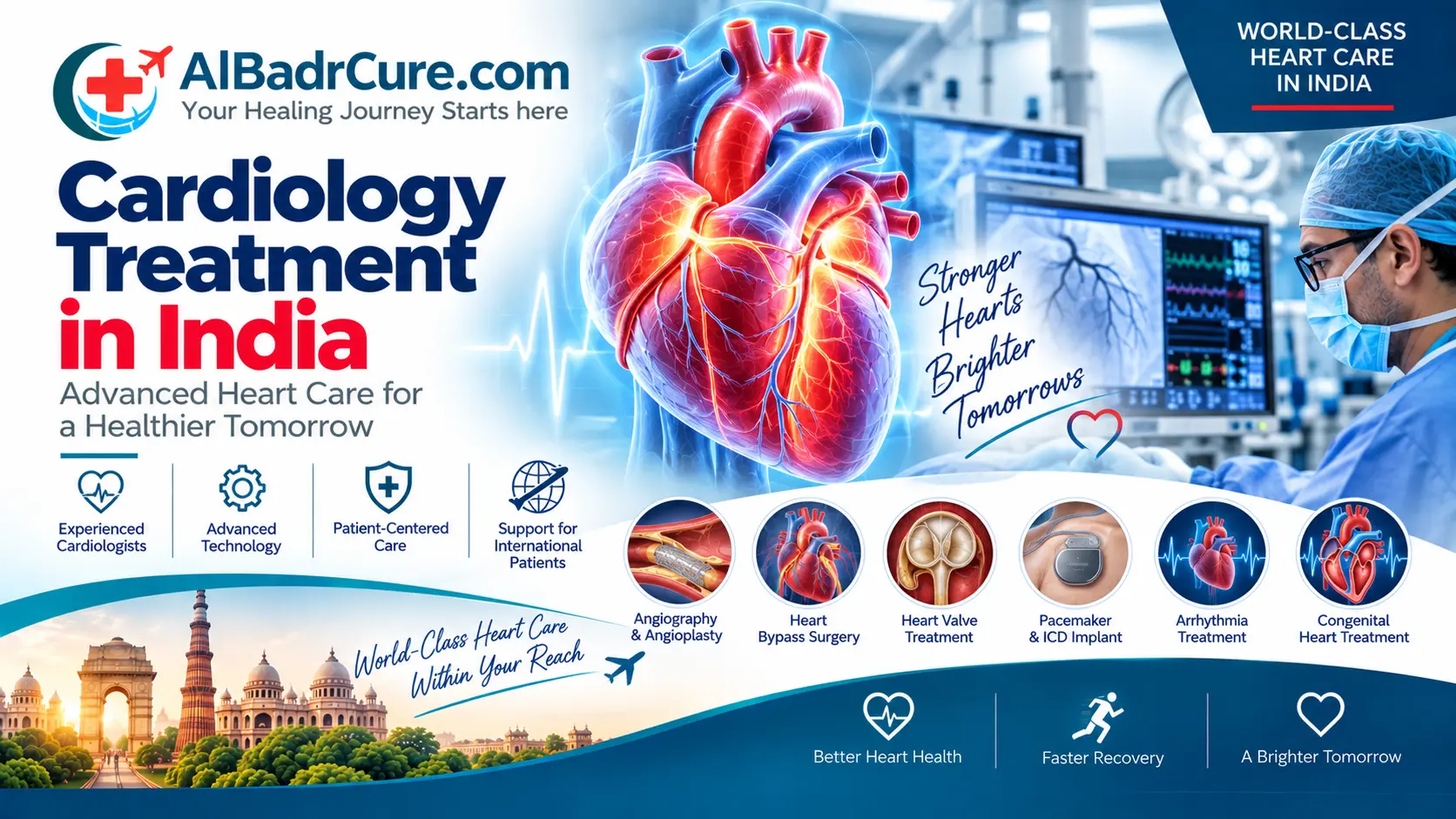
Cardiology treatment in India encompasses the prevention, diagnosis and treatment of diseases affecting the heart and blood vessels. Modern cardiac centres provide a broad spectrum of care, from non-invasive investigations and coronary angiography to angioplasty, bypass surgery, valve procedures, electrophysiology, device implantation and advanced heart-failure therapies.
For international patients, India offers access to multidisciplinary cardiac teams and hospitals equipped with catheterization laboratories, cardiac operating theatres, advanced imaging and intensive cardiac-care facilities. The exact treatment depends on the patient's diagnosis, severity of disease, age, medical history and overall risk profile.
Treatment Type: Medical, Interventional & Surgical
Specialty: Cardiology & Cardiothoracic Surgery
Hospital Stay: Same day to several days, depending on the procedure
Recovery: From a few days to several weeks or longer for major cardiac surgery
Anaesthesia: Local, sedation, regional or general, depending on the procedure
Cardiac care begins with an accurate diagnosis. Depending on the symptoms and suspected condition, a cardiologist may use ECG, echocardiography, stress testing, CT coronary angiography, cardiac catheterization, coronary angiography, Holter monitoring or other specialized investigations.
Treatment may then involve lifestyle and medication-based management, catheter-based intervention, cardiac devices or open/minimally invasive surgery.
Major Indian cardiac centres offer treatment across interventional cardiology, electrophysiology, structural heart disease, cardiac surgery, heart failure and transplantation.
✔️ Helps diagnose and manage cardiovascular disease
✔️ Restores blood flow in selected blocked coronary arteries
✔️ Treats selected heart-valve disorders
✔️ Manages abnormal heart rhythms
✔️ Provides advanced treatment for heart failure
✔️ Supports treatment of congenital heart defects
✔️ Offers surgical and minimally invasive options for appropriate patients
✔️ Enables long-term cardiac monitoring and rehabilitation
Coronary angiography is an invasive diagnostic procedure used to visualize the coronary arteries and identify narrowing or blockages. It can help the cardiologist determine whether medication, angioplasty or bypass surgery may be appropriate.
Percutaneous Coronary Intervention (PCI) uses a catheter to open a narrowed or blocked coronary artery. A balloon may be used to widen the vessel and a stent may be placed to help maintain blood flow.
Advanced centres may also offer techniques such as IVUS, OCT, rotational atherectomy and intravascular lithotripsy for selected complex coronary lesions.
CABG creates a new route for blood to reach the heart muscle when coronary arteries are significantly narrowed or blocked.
Depending on the patient's condition, surgeons may perform conventional, off-pump, minimally invasive or other forms of bypass surgery.
Diseased heart valves may sometimes be repaired or replaced.
Treatment options can include:
Surgical valve repair
Mechanical valve replacement
Biological/tissue valve replacement
TAVR/TAVI for selected aortic valve disease
Transcatheter edge-to-edge repair for selected valve conditions
The choice depends on the affected valve, severity of disease, anatomy and surgical risk.
Transcatheter Aortic Valve Replacement/Implantation is a minimally invasive procedure used to replace a diseased aortic valve in appropriately selected patients.
Unlike conventional open valve replacement, the new valve can be delivered through a catheter. Its suitability depends on detailed cardiac imaging and assessment by a heart team.
A pacemaker is a small electronic device used to help regulate the heart rhythm when the heart beats too slowly or when certain conduction disorders are present.
Some centres also offer newer technologies such as leadless pacemakers and conduction-system pacing for selected patients.
An Implantable Cardioverter-Defibrillator (ICD) monitors heart rhythm and can deliver therapy when a dangerous ventricular arrhythmia occurs.
It may be recommended for selected patients at significant risk of life-threatening ventricular arrhythmias.
Cardiac Resynchronization Therapy (CRT) uses specialized pacing to coordinate the contraction of the heart's ventricles in selected patients with heart failure and electrical conduction abnormalities.
A CRT-D device combines resynchronization therapy with defibrillation capability.
Electrophysiology procedures identify abnormal electrical circuits in the heart. Catheter ablation can then be used to treat selected rhythm disorders.
Modern electrophysiology centres may use 3D mapping and radiofrequency ablation to identify and treat abnormal electrical pathways.
Advanced heart-failure programmes may include medication optimization, device therapy, minimally invasive procedures, mechanical circulatory support and heart transplantation for appropriately selected patients. Some Indian centres also provide LVAD implantation and heart transplantation.
Congenital heart defects can affect children or adults. Selected defects may be treated using catheter-based procedures, while others require open or minimally invasive cardiac surgery.
Procedures may include device closure of selected ASD or VSD, congenital valve procedures and corrective cardiac surgery.
Selected cardiac operations can be performed through smaller incisions or robotic-assisted techniques. These approaches are not suitable for every patient and depend on the type of cardiac problem, anatomy and surgical expertise.
Cardiology and cardiac surgery centres may treat:
Coronary artery disease
Heart attack
Angina
Heart failure
Heart-valve disease
Arrhythmias
Cardiomyopathy
Congenital heart defects
Aortic disorders
Hypertension-related heart disease
Structural heart disease
Peripheral vascular conditions
Selected pulmonary hypertension conditions
Advanced heart failure requiring mechanical support or transplantation
The appropriate specialist and treatment pathway depend on the specific cardiovascular condition.
Includes medication, lifestyle modification, risk-factor management and long-term monitoring.
Uses catheter-based techniques such as angioplasty, stenting, structural heart procedures and selected congenital interventions.
Focuses on abnormal heart rhythms and includes procedures such as catheter ablation and device implantation.
Includes CABG, valve surgery, aortic procedures and other open or minimally invasive heart operations.
May include specialized medication, CRT, ICD, LVAD and transplantation in appropriately selected patients.
Cardiac treatment may be recommended to:
Improve blood flow to the heart
Relieve symptoms such as angina and breathlessness
Treat or prevent complications of coronary artery disease
Correct significant valve dysfunction
Control abnormal heart rhythms
Improve heart function in selected heart-failure patients
Repair or manage congenital heart defects
Reduce the risk of serious cardiovascular complications
Support patients with advanced heart disease
The objective is not simply to perform a procedure, but to select the appropriate treatment for the patient's cardiovascular condition.
A cardiologist may recommend different tests depending on the patient's symptoms and medical history.
Common investigations include:
Electrocardiogram (ECG)
Echocardiography
Stress testing
Holter monitoring
Blood tests
Lipid profile
Cardiac biomarkers
CT coronary angiography
Cardiac MRI
Coronary angiography
Cardiac catheterization
Electrophysiological study
Nuclear cardiac imaging in selected cases
Advanced cardiac centres may also use IVUS, OCT and other intravascular imaging technologies to assess coronary arteries and guide complex interventions.
Common symptoms associated with cardiovascular disease include:
⚠️ Chest pain or pressure
⚠️ Shortness of breath
⚠️ Unexplained fatigue
⚠️ Palpitations or irregular heartbeat
⚠️ Dizziness or fainting
⚠️ Swelling of the legs or ankles
⚠️ Reduced exercise tolerance
⚠️ Recurrent discomfort spreading to the arm, shoulder, jaw or back
Sudden severe chest pain, difficulty breathing, fainting, or symptoms suggestive of a heart attack require emergency medical attention rather than routine outpatient evaluation.
The treatment pathway depends on whether the patient requires medication, catheter-based intervention, a device or surgery.
The cardiologist reviews symptoms, medical history, risk factors, previous investigations and current medications.
Appropriate cardiac tests are performed to identify the underlying problem and determine its severity.
The cardiac team determines whether medical treatment, an interventional procedure, device therapy or surgery is appropriate.
For an invasive procedure, the patient may undergo blood tests, imaging, anaesthesia evaluation and medication adjustments.
The selected treatment is performed in a catheterization laboratory, electrophysiology laboratory or cardiac operating theatre.
Patients may be monitored in a recovery area, cardiac ICU or regular ward depending on the complexity of treatment.
Medication management, cardiac rehabilitation, lifestyle changes and follow-up investigations may form part of long-term care.
IVUS provides detailed images from inside a coronary artery and can assist in evaluating lesions and guiding selected stent procedures.
OCT provides high-resolution intravascular imaging and can help cardiologists assess coronary lesions and stent placement in selected cases.
Three-dimensional mapping systems help specialists identify abnormal electrical activity during selected arrhythmia procedures.
Selected heart operations can be performed using minimally invasive or robotic-assisted techniques, depending on the patient's anatomy and the procedure required.
Devices such as LVADs may be used in carefully selected patients with advanced heart failure, including as a bridge to transplantation or as long-term support in appropriate cases.
Recovery varies substantially according to the procedure.
💊 After coronary angiography: Many uncomplicated diagnostic procedures involve relatively short observation.
💊 After angioplasty: Recovery is generally shorter than after open-heart surgery, although activity and medication instructions must be followed carefully.
💊 After pacemaker or ICD implantation: Patients require wound care and follow-up to check device function.
💊 After CABG or valve surgery: Recovery generally takes several weeks and includes gradual physical activity, medication management and follow-up.
💊 After major cardiac surgery: Cardiac rehabilitation may be recommended to improve physical recovery and support long-term cardiovascular health.
The risks of cardiac treatment vary according to the procedure, underlying disease and patient's overall health.
Potential complications may include:
⚠️ Bleeding
⚠️ Infection
⚠️ Blood-vessel injury
⚠️ Abnormal heart rhythm
⚠️ Blood clots
⚠️ Stroke
⚠️ Kidney complications
⚠️ Reaction to contrast material
⚠️ Anaesthesia-related complications
⚠️ Heart attack
⚠️ Need for additional intervention or surgery
Major cardiac surgery carries additional procedure-specific risks, which should be discussed individually with the cardiac team.
India has developed extensive cardiac-care infrastructure combining interventional cardiology, cardiac surgery, electrophysiology, structural heart programmes and advanced heart-failure services. Major centres offer catheterization laboratories, advanced cardiac imaging, intensive care and multidisciplinary cardiac teams.
For example, major Indian cardiac centres currently advertise services including complex coronary intervention, TAVR/TAVI, electrophysiology, pacemaker and ICD implantation, CABG, minimally invasive and robotic cardiac surgery, LVAD and transplantation.
Potential factors for international patients include:
Experienced cardiologists and cardiac surgeons
Advanced catheterization laboratories
Availability of interventional and surgical cardiac procedures
Specialized electrophysiology services
Structural heart interventions
Cardiac intensive-care facilities
Multidisciplinary heart teams
International patient coordination
Potentially competitive treatment costs
Treatment availability and pricing vary between hospitals, cities, procedures and individual patient requirements.
The cost of cardiac treatment depends on several factors, including:
Type of procedure
Hospital and city
Cardiologist or cardiac surgeon
Complexity of the disease
Type of stent, valve or implanted device
ICU and hospital stay
Diagnostic investigations
Additional complications
Post-operative requirements
For this reason, a fixed price should not be assumed before medical evaluation. AlBadrCure can help international patients obtain a case-specific treatment estimate from the selected hospital.
International patients can begin the process by sharing their medical records, previous angiography reports, ECGs, echocardiograms, CT scans and medication history.
AlBadrCure can assist with:
✔️ Medical record evaluation
✔️ Cardiologist and cardiac surgeon consultation coordination
✔️ Second-opinion coordination
✔️ Hospital selection and treatment planning
✔️ Treatment cost estimates
✔️ Medical visa invitation assistance
✔️ Airport reception
✔️ Accommodation arrangements
✔️ Arabic/English language support
✔️ Hospital coordination
✔️ Post-treatment follow-up assistance
For patients considering major cardiac surgery or transplantation, obtaining a specialist opinion before travelling can help clarify the diagnosis, treatment options and expected hospital stay.
Not every blocked artery requires bypass surgery, and not every valve disorder requires open-heart surgery.
For some patients, medication may be sufficient. Others may require angioplasty and stenting, while patients with complex coronary disease may be evaluated for CABG. Similarly, selected valve disorders can be treated through catheter-based procedures such as TAVR/TAVI, while others require surgical repair or replacement.
The correct treatment depends on the individual patient's anatomy, disease severity, risk profile and clinical evaluation.
A multidisciplinary Heart Team approach may be particularly useful for complex coronary, valve and structural heart conditions.
Cardiology Treatment in India encompasses comprehensive care ranging from preventive cardiology and diagnostic testing to angioplasty, bypass surgery, valve interventions, electrophysiology, device implantation and advanced heart-failure treatment.
With modern catheterization laboratories, cardiac operating theatres, advanced imaging and specialized cardiac teams, Indian hospitals can provide a broad range of treatment options for both routine and complex cardiovascular conditions.
For international patients, the most important steps are obtaining an accurate diagnosis, consulting an appropriately qualified cardiac specialist and selecting a hospital equipped to provide the treatment required.
This article is intended for general educational purposes and does not replace consultation with a qualified cardiologist or cardiac surgeon. The appropriate treatment, procedure, hospital stay, risks and recovery period vary from patient to patient. Chest pain, severe breathlessness, fainting or suspected heart-attack symptoms require immediate emergency medical attention.
Our expert team at Albadrcure will personally assist you with:
Trusted by 20,000+ Patients Worldwide
Quick Response | Human Support | 100% Confidential
Fill the form to get a callback from our medical team!