
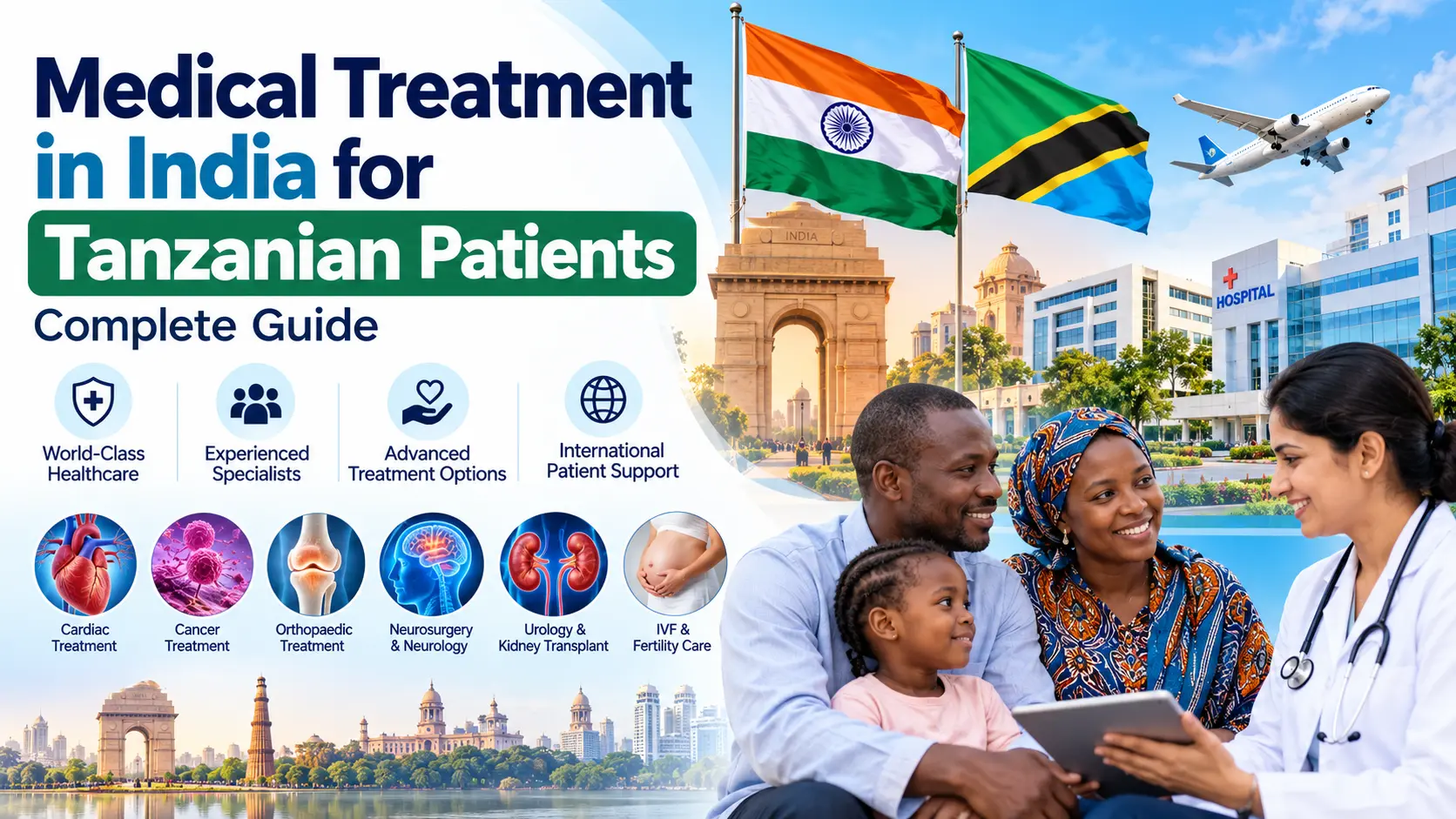
Medical Treatment in India for Tanzanian Patients: Complete Guide 2026
For patients from Tanzania seeking specialised medical care abroad, India has become an important destination for procedures ranging from cardiac surgery and cancer treatment to orthopaedics, kidney transplantation, neurosurgery and fertility care. Indian hospitals offer multidisciplinary specialist care, advanced diagnostic facilities and a wide range of treatment options across major healthcare cities.
For Tanzanian patients, however, arranging treatment abroad involves more than selecting a hospital. Medical records, specialist consultation, hospital estimates, visa requirements, Yellow Fever documentation, travel arrangements and post-treatment follow-up all need to be planned carefully.
This guide explains the key steps involved in planning medical treatment in India for Tanzanian patients, including treatment options, visa requirements, travel preparation and international-patient support.
Important: Visa and travel regulations can change. Tanzanian patients should verify the latest requirements with the High Commission of India or the official Indian visa portal before travelling.
Why Choose India for Medical Treatment?
India has developed a large medical-value-travel sector serving patients from Asia, Africa, the Middle East and other regions. The Government of India has also introduced the official Medical Value Travel (MVT) portal, Heal in India, to help international patients access information and navigate healthcare services. (Tourism India)
Some of the factors that make India attractive to international patients include:
-
Access to experienced specialists across multiple medical disciplines
-
Advanced diagnostic and surgical facilities
-
Robotic and minimally invasive procedures in selected specialties
-
Multidisciplinary treatment teams
-
Hospitals experienced in caring for international patients
-
Treatment options across different levels of complexity
-
Availability of English-speaking medical professionals
-
International patient departments providing assistance with appointments and coordination
Treatment decisions should always be based on the patient's medical condition, specialist recommendation, hospital accreditation and individual treatment plan rather than destination alone.
Medical Treatments Available in India for Tanzanian Patients
Tanzanian patients can seek treatment in India for a wide range of medical conditions.
❤️ Cardiac Treatment
Indian hospitals provide comprehensive cardiac care, including:
-
Coronary angioplasty and stenting
-
Coronary artery bypass surgery
-
Valve replacement and repair
-
Congenital heart surgery
-
Paediatric cardiac surgery
-
Structural heart procedures
-
Electrophysiology and ablation
-
Cardiac rehabilitation
🎗️ Cancer Treatment
Cancer centres in India provide multidisciplinary oncology services such as:
-
Medical oncology
-
Surgical oncology
-
Radiation therapy
-
Chemotherapy
-
Immunotherapy
-
Targeted therapy
-
Precision oncology
-
Bone marrow and stem cell transplantation
-
Selected radiosurgery techniques such as CyberKnife and Gamma Knife
The appropriate treatment depends on the cancer type, stage, pathology and overall health of the patient.
🦴 Orthopaedic Treatment
Common procedures include:
-
Total knee replacement
-
Hip replacement
-
Shoulder replacement
-
Revision joint replacement
-
Arthroscopy
-
Sports injury treatment
-
Spine surgery
-
Fracture and trauma surgery
-
Robotic-assisted joint replacement
🧠 Neurosurgery & Neurology
Patients may seek specialised treatment for:
-
Brain tumours
-
Spine disorders
-
Parkinson's disease
-
Epilepsy
-
Stroke-related conditions
-
Hydrocephalus
-
Spinal tumours
-
Degenerative spine conditions
-
Selected neurological disorders requiring surgery or advanced intervention
🫘 Kidney & Urology Treatment
Treatment options include:
-
Kidney stone treatment
-
Urological cancer treatment
-
Prostate surgery
-
Robotic urological surgery
-
Kidney transplantation
-
Renal failure management
-
Paediatric urology
-
Uro-oncology
🫀 Liver Transplant & Gastrointestinal Treatment
Indian transplant and hepatobiliary centres provide treatment for selected patients requiring:
-
Liver transplantation
-
Liver cancer treatment
-
Biliary surgery
-
Pancreatic surgery
-
Gastrointestinal surgery
-
Advanced hepatology care
👶 Paediatric Treatment
Specialised paediatric centres provide treatment for:
-
Congenital heart disease
-
Paediatric cancers
-
Blood disorders
-
Bone marrow transplantation
-
Paediatric neurological conditions
-
Paediatric orthopaedic conditions
-
Complex congenital disorders
🌸 IVF & Fertility Treatment
Tanzanian couples may also travel to India for:
-
IVF
-
ICSI
-
Fertility evaluation
-
Egg and sperm-related treatments
-
Embryo transfer
-
Male infertility treatment
-
Reproductive endocrinology
-
Selected fertility preservation services
Major Medical Treatment Cities in India
The choice of city should depend on the required specialty, hospital and treating team.
New Delhi & Delhi NCR
Delhi NCR is one of India's major healthcare destinations and includes hospitals in New Delhi, Gurugram, Noida and Faridabad.
Common specialties include:
-
Cardiology
-
Cardiac surgery
-
Oncology
-
Neurosurgery
-
Orthopaedics
-
Kidney transplantation
-
Urology
-
IVF
-
Paediatric surgery
-
Gastroenterology and liver transplantation
Mumbai
Mumbai has major tertiary and quaternary-care hospitals providing oncology, cardiac surgery, transplantation, neurosurgery and other specialised services.
Chennai
Chennai is known for its large network of tertiary hospitals and is particularly prominent in areas such as cardiac care, transplantation, orthopaedics and complex surgery.
Hyderabad
Hyderabad provides specialised treatment in oncology, cardiology, transplantation, neurosurgery, orthopaedics and other disciplines.
Bengaluru
Bengaluru has advanced hospitals offering cardiac care, oncology, neurosurgery, transplantation, orthopaedics, fertility care and robotic surgery.
How Tanzanian Patients Can Plan Treatment in India
A structured process can make international treatment easier.
Step 1: Collect Medical Records
Before contacting Indian hospitals, prepare available:
-
Doctor's referral letter
-
Diagnosis reports
-
Blood investigations
-
CT/MRI scans
-
X-rays
-
Biopsy and pathology reports
-
Previous surgery records
-
Discharge summaries
-
Current medication list
-
Previous treatment history
For imaging, patients should keep the original digital files where possible, rather than only printed reports.
Step 2: Get a Medical Opinion
The patient's medical documents can be reviewed by an appropriate Indian specialist.
The specialist may provide an initial opinion regarding:
-
Possible diagnosis
-
Recommended investigations
-
Possible treatment options
-
Expected hospital stay
-
Approximate treatment duration
-
Whether surgery may be required
A final treatment plan is normally confirmed after clinical examination and necessary investigations in India.
Step 3: Select the Hospital
Patients should compare hospitals based on:
-
Relevant specialty
-
Doctor's experience
-
Hospital accreditation
-
Required technology
-
Intensive-care facilities
-
Transplant infrastructure where relevant
-
International patient services
-
Expected treatment duration
-
Total estimated cost
Step 4: Obtain the Hospital Letter
For India's e-Medical Visa, the official e-Visa system requires a letter from the Indian hospital on its letterhead stating the tentative date of admission/treatment. The document should include the patient's name, nationality and passport number. (India Visa Online)
Step 5: Apply for the Appropriate Visa
Tanzanian patients should use the appropriate Medical Visa or e-Medical Visa route, depending on their eligibility and circumstances.
Step 6: Plan Travel & Accommodation
After the visa is approved, arrange:
-
Flights
-
Airport transfer
-
Hotel or serviced apartment
-
Hospital admission
-
Local transportation
-
Attendant accommodation
-
Interpreter support if required
Step 7: Treatment & Follow-Up
After admission, the treating team may conduct additional investigations before confirming the treatment plan.
After treatment, the patient should obtain:
-
Discharge summary
-
Prescription
-
Investigation reports
-
Operative notes where applicable
-
Follow-up instructions
-
Copies of imaging and pathology reports
Medical Visa for Tanzanian Patients Travelling to India
The High Commission of India in Dar es Salaam provides specific guidance for medical and medical escort visas.
The Medical Visa is intended for specialised medical treatment in India. According to the High Commission, its validity may be up to six months, one year, or the period of treatment, whichever is shorter, subject to applicable rules.
Documents Mentioned by the Indian High Commission
Tanzanian applicants may need:
-
Preliminary medical advice confirming the need for specialised treatment and referral to India, or
-
Appointment letter from a recognised Indian medical institution
-
Documentary proof of financial standing
-
Valid passport
-
Other documents required under the applicable visa process
The High Commission can request additional information or documents when necessary.
Medical Attendant Visa
Family members or attendants travelling with the patient can apply for a Medical Escort/Attendant Visa.
The High Commission states that:
-
Up to two attendants may accompany the patient.
-
The attendant visa is issued for the same period as the patient's medical visa.
-
Medical and medical escort visa holders are required to register with the concerned FRRO/FRO within 14 days of arrival where applicable. (HC Indiatz)
e-Medical Visa for Tanzanian Patients
Tanzania is listed among the countries eligible for India's e-Visa system. The official Indian e-Visa portal includes e-Medical Visa and e-Medical Attendant Visa categories.
For e-Medical and e-Medical Attendant visas, eligible applicants may apply online at least 4 days before arrival, with an arrival-date selection window of up to 120 days under the current instructions. (India Visa Online)
The current e-Visa information also states that up to two e-Medical Attendant Visas can be issued against one e-Medical Visa.
e-Medical Visa Documents
The official portal specifies:
-
Passport biodata page
-
Recent photograph
-
Indian hospital letter for the e-Medical Visa
The hospital letter should include the tentative admission/treatment date and patient identification details. (India Visa Online)
Always check the official portal immediately before applying, as eligibility, fees, documentation and processing rules may change.
Yellow Fever Requirements for Tanzanian Patients
Yellow Fever documentation is an important part of travel planning for patients coming from Tanzania.
The Indian High Commission in Dar es Salaam lists a valid Yellow Fever Vaccination Certificate among the visa/travel requirements for Tanzanian applicants.
India's Ministry of Health and Family Welfare states that travellers arriving from Yellow Fever endemic countries must carry a valid Yellow Fever vaccination certificate. The certificate becomes valid 10 days after vaccination and, under current international rules, remains valid for life.
India's health authorities also warn that passengers arriving without a valid certificate may be subject to quarantine procedures.
Important Travel Tip
Do not leave Yellow Fever vaccination arrangements until the last minute. Patients should:
-
Check the latest Indian entry requirements.
-
Obtain vaccination through an authorised centre.
-
Carry the original Yellow Fever vaccination certificate.
-
Ensure personal details match the passport.
-
Allow at least 10 days after vaccination for the certificate to become valid.
Patients with medical contraindications should discuss vaccination requirements with an appropriate doctor and verify the applicable travel-health rules.
India Medical Treatment Cost for Tanzanian Patients
The cost of treatment in India varies significantly depending on:
-
Diagnosis
-
Treatment complexity
-
Hospital
-
Doctor
-
Type of surgery
-
Implant or device requirements
-
ICU requirements
-
Length of hospital stay
-
Additional investigations
-
Complications
-
Rehabilitation
-
Follow-up care
Therefore, there is no single medical treatment price for Tanzanian patients.
For example, the cost of a knee replacement cannot be reliably quoted without knowing the type of implant, surgical approach, hospital, surgeon and patient's medical requirements.
What a Treatment Estimate May Include
A hospital quotation may cover some or all of the following:
-
Surgeon fees
-
Hospital charges
-
Operation theatre charges
-
Anaesthesia
-
Room charges
-
Nursing
-
Medicines
-
Investigations
-
Medical consumables
-
Implant/device costs
-
ICU charges where applicable
Patients should ask the hospital or medical facilitator for a written treatment estimate and clarify what is excluded.
What Tanzanian Patients Should Carry to India
Before travelling, prepare a medical travel folder containing:
Medical Documents
-
Passport
-
Medical reports
-
Referral letter
-
Prescriptions
-
Imaging reports
-
CT/MRI/X-ray records
-
Pathology reports
-
Previous discharge summaries
-
Current medication list
Travel Documents
-
Indian visa/e-Visa approval
-
Hospital invitation/appointment letter
-
Flight tickets
-
Hotel/accommodation details
-
Yellow Fever vaccination certificate
-
Travel insurance documents, where applicable
-
Emergency contact information
Financial Preparation
Patients should have access to sufficient funds for:
-
Hospital treatment
-
Medicines
-
Accommodation
-
Food
-
Local transportation
-
Additional investigations
-
Possible extended hospitalisation
-
Follow-up appointments
The Indian High Commission specifically requires documentary proof of financial standing for the Medical Visa route.
Accommodation for Tanzanian Patients in India
Patients may need accommodation close to their hospital for several weeks depending on the treatment.
Suitable options can include:
-
Hotels near the hospital
-
Serviced apartments
-
Hospital guest facilities where available
-
Long-stay accommodation
For major procedures, accommodation should ideally provide easy access to the treating hospital and basic facilities suitable for the patient's recovery.
For patients with mobility limitations, families should consider:
-
Lift access
-
Wheelchair accessibility
-
Attached bathroom
-
Kitchen facilities
-
Hospital transport
-
Distance from the hospital
Language & Communication Support
English is widely used in Indian hospitals, particularly among doctors and international patient departments.
Tanzanian patients may communicate comfortably in English, while families may also use Swahili or other languages. Where necessary, an international patient coordinator or interpreter can help with communication.
Clear communication is particularly important when discussing:
-
Diagnosis
-
Surgical consent
-
Medication
-
Treatment risks
-
Expected recovery
-
Follow-up appointments
-
Discharge instructions
How AlBadrCure Can Support Tanzanian Patients
AlBadrCure can help international patients organise their medical journey in India from the initial enquiry through treatment and follow-up.
Our support can include:
✔️ Collection and organisation of medical records
✔️ Connecting patients with relevant specialists
✔️ Hospital and doctor coordination
✔️ Preliminary treatment planning
✔️ Treatment cost estimates
✔️ Appointment scheduling
✔️ Medical visa documentation support
✔️ Airport and local travel coordination
✔️ Accommodation assistance
✔️ Interpreter and communication support where required
✔️ Hospital admission coordination
✔️ Discharge and follow-up assistance
The objective is to reduce administrative difficulties so that patients and families can focus on their healthcare.
Step-by-Step Medical Travel Journey from Tanzania to India
1. Medical enquiry
Share your diagnosis and medical records.
2. Specialist evaluation
The relevant Indian specialist reviews the available reports.
3. Hospital selection
Choose the appropriate hospital and treatment team.
4. Treatment estimate
Receive an estimated treatment plan and cost.
5. Hospital invitation
Obtain the required hospital appointment/invitation documentation.
6. Medical Visa/e-Medical Visa
Apply through the appropriate official route.
7. Travel preparation
Arrange flights, accommodation and local transportation.
8. Arrival in India
Complete hospital admission and further evaluation.
9. Treatment
Undergo the recommended medical or surgical treatment.
10. Recovery & discharge
Receive medicines, reports and follow-up instructions.
11. Return to Tanzania
Travel home when medically cleared.
12. Follow-up
Continue follow-up with the Indian specialist remotely or during a subsequent visit when required.
Why Planning Matters for International Patients
Medical travel involves more variables than ordinary tourism. A patient may initially plan a short stay but require additional investigations, treatment or rehabilitation.
Therefore, Tanzanian patients should avoid booking a very tight return schedule immediately after major surgery.
It is better to discuss with the treating hospital:
-
Expected hospitalisation
-
Recovery period
-
Follow-up schedule
-
Whether stitches/staples need removal
-
When air travel is considered appropriate
-
Whether additional treatment may be required
-
What medical documents should be taken home
The final decision regarding fitness to travel should come from the treating medical team.
Final Checklist for Tanzanian Patients
Before travelling to India, make sure you have:
✔️ Valid passport
✔️ Medical reports and imaging
✔️ Doctor's referral
✔️ Indian hospital appointment/invitation letter
✔️ Approved Medical Visa/e-Medical Visa
✔️ Yellow Fever vaccination certificate, where required
✔️ Adequate financial arrangements
✔️ Flight tickets
✔️ Accommodation
✔️ Hospital appointment
✔️ Emergency contact details
✔️ Complete list of current medicines
Conclusion
Medical treatment in India for Tanzanian patients can be organised through a structured process involving medical evaluation, hospital selection, treatment planning, visa preparation and travel coordination. India offers a broad range of specialised healthcare services, from cardiac and cancer treatment to orthopaedics, transplantation, neurosurgery, urology and fertility care.
For Tanzanian patients, careful preparation is particularly important. Medical records should be organised before travel, the appropriate Indian hospital should be selected based on the required specialty, and visa and Yellow Fever requirements should be verified before departure.
With appropriate planning and coordination, patients and their families can approach their treatment journey with clearer expectations and better logistical preparation.
AlBadrCure can assist Tanzanian patients in coordinating consultations, hospitals, treatment estimates, medical travel arrangements and international-patient support in India.
Medical Disclaimer
This article is intended for general informational purposes and does not replace professional medical advice. Treatment suitability, risks, costs and expected recovery vary between patients. Medical decisions should be made in consultation with qualified healthcare professionals. Visa, immigration, vaccination and travel requirements may change, so patients should verify current requirements with the relevant Indian authorities before travelling.