
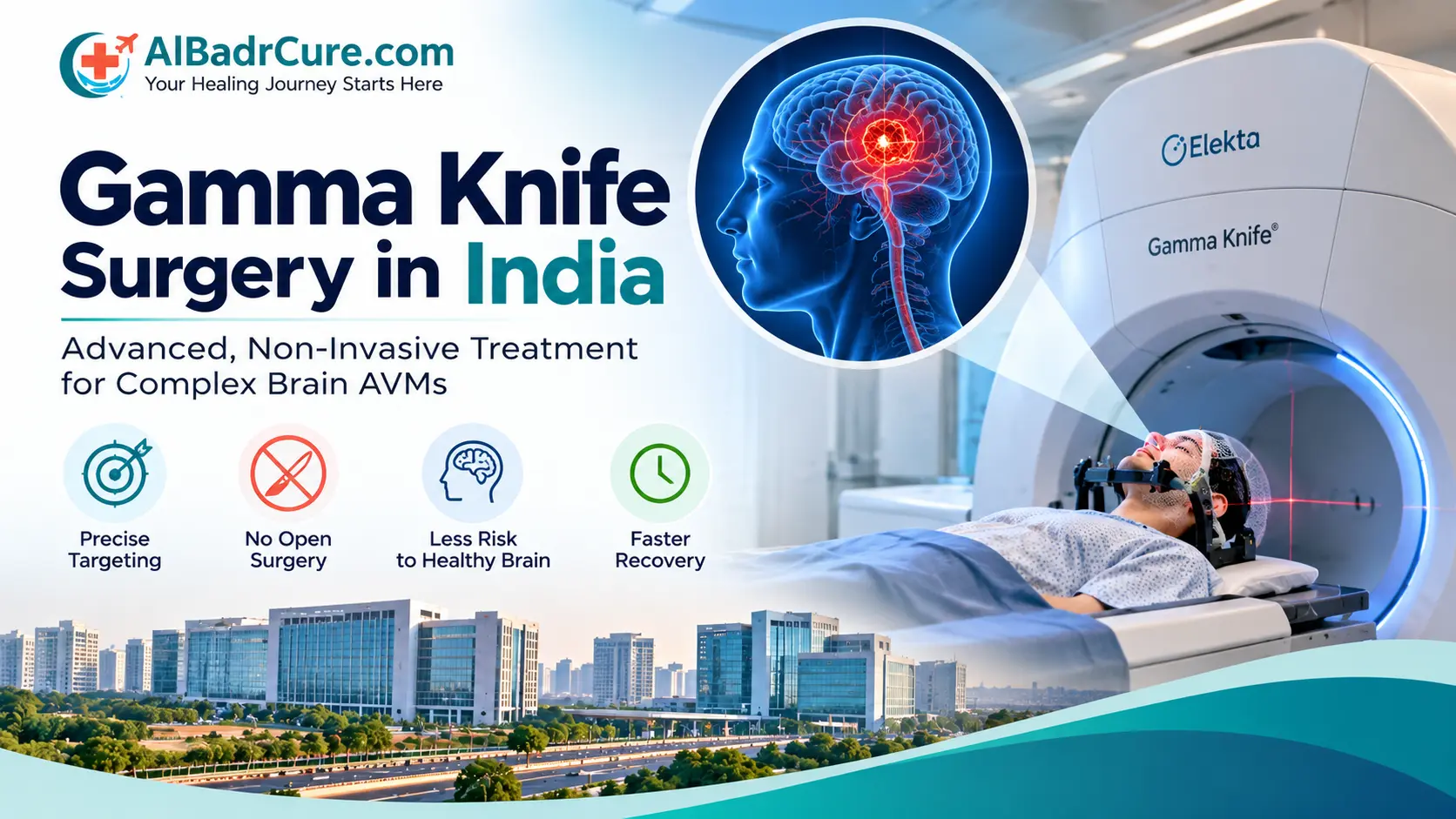
Gamma Knife Surgery in India: Advanced Treatment for Complex Brain AVMs
Gamma Knife radiosurgery in India has become an important treatment option for selected patients with complex brain conditions, particularly arteriovenous malformations (AVMs) and certain other brain lesions. Unlike conventional brain surgery, Gamma Knife treatment does not require an incision or opening of the skull. Instead, it uses highly focused radiation to target the abnormal area while limiting radiation exposure to surrounding healthy brain tissue.
For patients and families considering treatment in India, the combination of specialized neurosurgical expertise, advanced radiation technology, detailed treatment planning and international-patient support can make India an option worth discussing with a qualified medical team.
What Is Gamma Knife Surgery?
Despite the word “knife,” Gamma Knife is not conventional surgery. It is a form of stereotactic radiosurgery that uses multiple precisely directed radiation beams.
In the treatment of a brain AVM, numerous radiation beams are focused on the abnormal blood vessels. Individually, the beams deliver relatively low radiation doses along their paths, while their combined effect is concentrated at the treatment target. This allows doctors to treat selected abnormalities while minimizing exposure to nearby healthy brain tissue.
The procedure is generally performed without a traditional surgical incision. Depending on the patient's condition and the treatment plan, the patient may remain awake during treatment and can often return home after the procedure.
What Is a Brain Arteriovenous Malformation?
A brain arteriovenous malformation (AVM) is an abnormal connection between arteries and veins. Instead of blood flowing through the normal network of smaller blood vessels, an AVM creates an unusual tangle of vessels.
The major concern with some brain AVMs is the possibility of bleeding. However, every AVM is different. Its size, location, blood-flow characteristics, symptoms and relationship with important areas of the brain all influence the treatment strategy.
For this reason, Gamma Knife is not automatically suitable for every AVM. A multidisciplinary team may consider radiosurgery alongside other approaches such as microsurgery or endovascular treatment.
How Does Gamma Knife Treatment Work?
The treatment process involves detailed preparation before radiation is delivered.
1. Medical Evaluation
The medical team reviews the patient's medical history, symptoms and previous investigations. Brain imaging is assessed to determine the exact location and characteristics of the abnormality.
2. Detailed Imaging
High-resolution MRI and, when appropriate, CT or other vascular imaging may be used to create a detailed representation of the target and surrounding brain structures.
3. Treatment Planning
A neurosurgeon and radiation oncology team use specialized planning software to determine the appropriate radiation dose and beam arrangement.
The objective is to deliver sufficient radiation to the target while minimizing unnecessary exposure to healthy tissue. This planning stage is particularly important because the target may be located close to critical neurological structures.
4. Gamma Knife Radiosurgery
During treatment, carefully calculated radiation beams are directed toward the target. There is no conventional surgical incision.
The exact treatment time depends on the individual treatment plan, target size and other clinical factors.
5. Follow-Up
Gamma Knife treatment does not necessarily make an AVM disappear immediately. Instead, the treated blood vessels can gradually undergo changes over time.
Regular follow-up imaging is therefore an important part of care. MRI and other investigations may be performed periodically to evaluate the response to treatment.
Why Is Gamma Knife Used for Brain AVMs?
For appropriately selected AVMs, Gamma Knife offers a way to treat abnormal blood vessels without physically removing them through open brain surgery.
This can be particularly relevant when an AVM is located in a difficult-to-access area of the brain or when conventional surgery may carry significant risks. However, suitability depends on individual anatomy and clinical circumstances.
The treatment decision may involve a multidisciplinary assessment involving:
-
Neurosurgeons
-
Radiation oncologists
-
Neurointerventional specialists
-
Neurologists
-
Neuroradiologists
The team may compare Gamma Knife with other available treatment strategies before recommending an approach.
Gamma Knife for Other Brain Conditions
Although AVMs are an important application, stereotactic radiosurgery can also be considered for selected intracranial conditions.
Depending on the technology available and the patient's clinical situation, radiosurgery may be used in the management of certain:
-
Brain tumors
-
Benign brain lesions
-
Vascular malformations
-
Recurrent or residual lesions
-
Other carefully selected neurological conditions
The exact indications vary by patient, and a specialist evaluation is essential before treatment.
What Are the Benefits of Gamma Knife Radiosurgery?
Gamma Knife may offer several advantages for appropriately selected patients.
No Conventional Brain Incision
Because the treatment uses focused radiation rather than surgical removal, there is no conventional surgical wound or skull incision.
Precise Targeting
Multiple radiation beams can be focused on a defined target, helping the treatment team concentrate radiation where it is needed.
Shorter Physical Recovery
Because there is no conventional surgical wound to heal, recovery can be considerably different from open brain surgery. Many patients can resume normal activities relatively quickly, depending on their condition and medical advice.
Outpatient or Short-Stay Treatment
Many Gamma Knife procedures do not require a prolonged hospital stay. The exact duration depends on the patient's medical condition and the treatment protocol.
Useful for Selected Difficult-to-Reach Lesions
Radiosurgery may provide an option for some lesions that are located in areas where open surgery could be technically challenging.
Gamma Knife Surgery Success and Outcomes
The outcome of Gamma Knife treatment depends on several factors, including:
-
Size of the AVM
-
Location of the AVM
-
AVM structure and blood-flow characteristics
-
Radiation dose
-
Patient's age and overall health
-
Previous treatments
-
Response to treatment
The source material reports that approximately 70–80% of brain AVMs treated with Gamma Knife may achieve complete closure over two to three years, but individual outcomes can vary considerably.
Importantly, Gamma Knife treatment often works gradually rather than immediately. Follow-up imaging is therefore necessary to determine whether the AVM has been successfully obliterated.
Patients should discuss their individual expected outcome with their treating neurosurgical and radiation oncology team rather than relying on a general success percentage.
Is Gamma Knife Surgery Painful?
Gamma Knife is generally considered a non-incisional treatment, and the source describes patients as remaining awake and experiencing no significant pain during treatment.
Some patients may experience temporary symptoms such as headache or fatigue after treatment. The possibility and severity of side effects depend on the treatment area, radiation dose and individual patient factors.
Any new neurological symptoms after treatment should be promptly discussed with the treating medical team.
Recovery After Gamma Knife Treatment
Recovery is usually different from recovery after open brain surgery because there is no large surgical wound.
Patients may be able to return to routine activities within a relatively short period, depending on their medical condition and doctor's advice. The source material notes that many patients resume work and normal activities within days.
However, recovery from the procedure and healing of the AVM are not the same thing. While physical recovery from treatment may be quick, the treated AVM may take months or years to gradually close.
Regular follow-up is therefore essential.
Possible Risks and Side Effects
Gamma Knife is designed to minimize damage to surrounding tissue, but stereotactic radiation is still a medical treatment and can have risks.
Possible effects may include:
-
Headache
-
Fatigue
-
Temporary swelling around the treated area
-
Radiation-related tissue changes
-
Neurological symptoms depending on the treatment location
-
Rarely, more significant complications
The risks depend heavily on the location and size of the lesion, radiation dose and individual patient characteristics.
A detailed discussion with the treating team is necessary before treatment.
Why Consider Gamma Knife Treatment in India?
India has developed advanced neurosurgical, neurointerventional and radiation oncology services, with several hospitals offering sophisticated treatment technologies.
The source material highlights the development of specialized Gamma Knife programs, internationally trained clinicians and modern treatment infrastructure in Indian hospitals.
For international patients, India may also provide access to treatment at comparatively lower healthcare costs than some Western healthcare systems. However, treatment cost varies according to the hospital, technology, doctor's expertise, diagnostic requirements and complexity of the case.
Rather than choosing a hospital based only on price, international patients should consider the experience of the treating team, available technology, multidisciplinary support and follow-up arrangements.
Gamma Knife Treatment for International Patients
Patients travelling to India for Gamma Knife treatment may require support with several aspects of their medical journey.
A medical tourism provider such as AlBadrCure can help international patients coordinate:
-
Medical record and report review
-
Specialist consultation
-
Hospital appointment coordination
-
Treatment planning assistance
-
Cost estimates
-
Visa-related support
-
Airport transfers
-
Accommodation
-
Language assistance
-
Local transportation
-
Follow-up coordination
Patients should carry previous MRI, CT, angiography reports, medical summaries, medication details and other relevant records when travelling for specialist evaluation.
Gamma Knife Surgery Cost in India
The cost of Gamma Knife treatment varies depending on the patient's diagnosis and treatment plan.
Factors that can influence the total cost include:
-
Hospital and location
-
Type and complexity of the lesion
-
Diagnostic imaging
-
Specialist consultation
-
Treatment planning
-
Number of treatment sessions, where applicable
-
Hospital stay
-
Follow-up investigations
-
Additional medical procedures
The source material gives an approximate range of USD 5,000–6,000 in India, compared with a higher reported range in the United States. These figures should be treated as indicative rather than a fixed quotation because actual treatment costs vary between patients and hospitals.
Choosing the Right Hospital and Specialist
Gamma Knife treatment is highly dependent on accurate diagnosis and treatment planning. Patients should consider hospitals where relevant specialists work together and where appropriate imaging and follow-up facilities are available.
Before proceeding, ask the medical team:
-
Is Gamma Knife appropriate for my condition?
-
What other treatment options are available?
-
What are the expected benefits and risks?
-
How long could the treatment take?
-
How many follow-up scans will be required?
-
What is the estimated total treatment cost?
-
What should I expect during the recovery period?
-
How will my condition be monitored after treatment?
These questions can help patients and families understand the treatment plan before making a decision.
Conclusion
Gamma Knife radiosurgery in India offers a non-incisional approach for selected brain AVMs and other neurological conditions. Its precision, relatively short physical recovery and ability to treat certain difficult-to-access lesions make it an important option within modern neurosurgical care.
However, Gamma Knife is not a one-size-fits-all treatment. The right approach depends on the patient's diagnosis, imaging findings, lesion characteristics and overall health. A detailed evaluation by an experienced multidisciplinary team is essential before deciding whether Gamma Knife, conventional surgery, endovascular treatment or another approach is appropriate.
For international patients considering treatment in India, obtaining a specialist opinion and a personalized treatment plan should be the first step.
Medical Disclaimer: This article is intended for general informational purposes only and should not replace consultation with a qualified neurosurgeon, radiation oncologist or other healthcare professional. Treatment suitability, risks, outcomes and costs vary from patient to patient.