
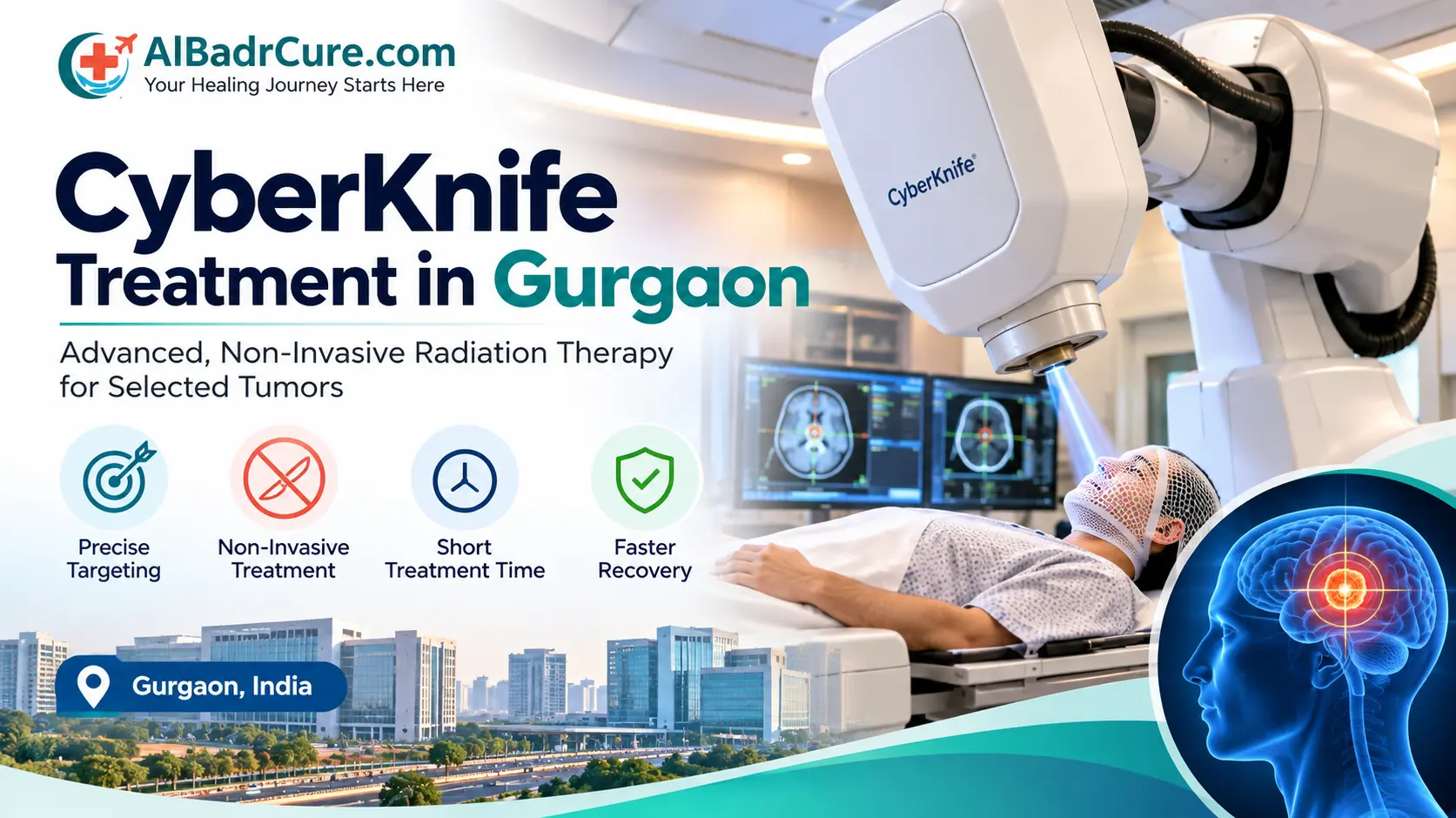
CyberKnife Treatment in Gurgaon, India: Cost, Procedure, Benefits & Hospitals
Advanced Robotic Radiosurgery for Selected Tumors
CyberKnife treatment in Gurgaon is a form of stereotactic radiosurgery (SRS) and stereotactic body radiation therapy (SBRT) that uses highly targeted radiation to treat selected tumors without conventional surgery. It can be considered for certain tumors in the brain, spine, lung, prostate, liver, kidney and pancreas, depending on the tumor's size, location, type and the patient's overall clinical condition.
For international patients considering treatment in India, Gurgaon offers access to hospitals providing advanced radiation oncology and multidisciplinary cancer services.
Quick Facts
Treatment: CyberKnife Radiosurgery
Treatment Type: Non-invasive stereotactic radiation therapy
Typical Session: 30–90 minutes
Number of Sessions: Often 1–5, depending on the treatment plan
Hospital Stay: Usually outpatient/day-care
Anaesthesia: Generally not required
Recovery: Usually short, but depends on the tumor and treatment area
Location: Gurgaon, India
Estimated Cost: Varies according to hospital, tumor type, treatment plan and number of sessions
What Is CyberKnife Treatment?
CyberKnife is a robotic radiation treatment system used to deliver highly focused radiation to tumors and other selected conditions for which radiation therapy is appropriate.
Unlike conventional surgery, CyberKnife does not require an incision. The system uses image guidance and robotic positioning to direct radiation beams toward the treatment target while attempting to limit exposure to surrounding healthy tissue. Modern CyberKnife systems also incorporate real-time target tracking and motion synchronization for selected indications.
Although the name includes "Knife," CyberKnife does not involve a surgical blade. It is a radiation-based treatment.
How Does CyberKnife Work?
CyberKnife combines:
-
Advanced imaging
-
Computerized treatment planning
-
A robotic treatment arm
-
Multiple radiation beam angles
-
Image-guided positioning
-
Motion tracking for selected tumors
The radiation is delivered from multiple directions and concentrated on the treatment target. This allows the radiation oncology team to create a highly conformal dose distribution around the tumor.
What Conditions Can CyberKnife Treat?
CyberKnife may be considered for selected tumors and lesions involving areas such as:
-
Brain
-
Spine
-
Lung
-
Prostate
-
Liver
-
Kidney
-
Pancreas
-
Head and neck
It may also be considered in certain recurrent or surgically difficult tumors. However, CyberKnife is not appropriate for every cancer or every patient. The radiation oncologist determines suitability after reviewing the diagnosis, imaging, tumor characteristics and previous treatments.
Who May Be a Candidate?
CyberKnife may be considered when:
-
A tumor is located close to important structures.
-
Conventional surgery may be difficult or unsuitable.
-
A highly focused radiation approach is clinically appropriate.
-
A previously treated tumor has recurred and stereotactic radiation is being considered.
-
The tumor's size, shape and location are suitable for stereotactic treatment.
Patient selection is individualized. Tumor type, stage, size, location, previous treatment, overall health and treatment objectives all influence the decision.
CyberKnife Treatment Process
1. Medical Consultation
A radiation oncologist reviews the patient's diagnosis, pathology, cancer stage and previous treatment.
2. Imaging & Evaluation
Detailed imaging is performed to determine the tumor's size, shape and precise location. These images form the basis of treatment planning.
3. Treatment Planning
A specialized treatment plan is created to deliver the prescribed radiation dose to the tumor while limiting radiation exposure to nearby normal structures.
4. CyberKnife Treatment
The patient is positioned on the treatment table while the robotic system delivers radiation from multiple angles. Image guidance may be used during treatment to monitor positioning and, where applicable, tumor motion.
Individual sessions may take approximately 30–90 minutes, depending on the treatment site and complexity.
5. Follow-Up
After treatment, the oncology team schedules clinical follow-up and appropriate imaging to evaluate the tumor response and monitor for treatment-related effects.
How Many Sessions Are Required?
CyberKnife is commonly delivered in a small number of high-dose treatment sessions, rather than the many sessions sometimes used in conventional radiation therapy.
The exact number depends on the tumor and treatment plan. The source reviewed for Gurgaon describes treatment courses of approximately 1–5 sessions.
Benefits of CyberKnife
Potential advantages for appropriately selected patients include:
-
Non-invasive treatment
-
No surgical incision
-
Highly focused radiation delivery
-
Shorter treatment schedules for some indications
-
Outpatient treatment in many cases
-
No conventional surgical recovery
-
Motion tracking capabilities for selected tumors
CyberKnife's robotic system is designed to deliver stereotactic radiation with high precision, including sub-millimeter treatment accuracy and motion synchronization capabilities on applicable systems.
CyberKnife vs Conventional Surgery
CyberKnife and surgery are different treatment approaches and are not interchangeable in every case.
CyberKnifeConventional SurgeryUses targeted radiationRemoves or directly treats tissue surgicallyNo surgical incisionUsually requires an incision or surgical accessUsually outpatientMay require hospitalizationShort treatment schedule for selected casesRecovery varies by procedureUseful for selected difficult-to-reach tumorsMay be preferred when physical tumor removal is appropriate
The appropriate treatment depends on the tumor and the patient's overall clinical situation.
Side Effects & Possible Risks
CyberKnife is generally designed to limit radiation exposure to surrounding tissues, but radiation treatment can still cause side effects.
Possible effects include:
-
Fatigue
-
Skin irritation
-
Pain or discomfort depending on the treated area
-
Effects related to the location of the tumor
-
Radiation-related injury to nearby tissues
The type and severity of side effects depend on factors such as the tumor location, radiation dose, treatment technique and the patient's general health. Some radiation-related effects can also occur later after treatment.
Recovery After CyberKnife
Because CyberKnife does not involve conventional surgery, recovery is generally different from surgical recovery.
Many patients can return to routine activities relatively quickly, but recovery varies according to:
-
Tumor location
-
Treatment dose
-
Number of sessions
-
Existing medical conditions
-
Side effects
Your radiation oncology team should provide individualized guidance about work, travel, exercise and follow-up after treatment.
CyberKnife Treatment Cost in Gurgaon
The cost of CyberKnife treatment depends on several factors, including:
-
Hospital
-
Tumor type and location
-
Number of treatment sessions
-
Imaging and diagnostic requirements
-
Treatment planning
-
Doctor and radiation oncology fees
-
Previous cancer treatment
-
Follow-up requirements
The MediGence Gurgaon page currently lists an overall estimated range of USD 6,000–18,000, while the same page separately states an average Gurgaon range of USD 4,500–7,500. Because these figures are not internally consistent, they should be treated as indicative rather than a fixed treatment price.
For a patient-specific estimate, medical records and imaging should be reviewed before a hospital quote is considered.
CyberKnife Hospitals in Gurgaon
The MediGence page currently lists two Gurgaon hospitals for CyberKnife treatment:
Artemis Health Institute
Artemis Health Institute in Gurgaon is listed with JCI and NABH accreditation and provides CyberKnife treatment with radiation oncology, imaging and treatment-planning infrastructure. The listed starting price on the reviewed page is USD 6,000.
Marengo Asia Hospitals, Gurugram
Marengo Asia Hospitals, Gurugram, is listed with NABH and NABL accreditation and has a 250+ bed capacity according to the reviewed MediGence listing. The listed CyberKnife starting price is USD 10,000.
Hospital availability, equipment, treatment protocols and prices can change, so patients should confirm the current information before making arrangements.
Why Consider Gurgaon for CyberKnife Treatment?
Gurgaon is part of the Delhi NCR healthcare ecosystem and has hospitals offering advanced oncology services, radiation oncology and multidisciplinary cancer care. The current MediGence listing identifies multiple accredited hospitals in Gurgaon offering CyberKnife treatment.
For international patients, the practical advantage can also include access to medical coordinators, airport connectivity, accommodation and other support services through healthcare facilitators such as AlBadrCure.
International Patient Support by AlBadrCure Healthcare
At AlBadrCure Healthcare, we help international patients explore CyberKnife treatment in India by coordinating:
-
Medical record review
-
Doctor consultation
-
Hospital selection
-
Treatment planning
-
Cost estimates
-
Appointment coordination
-
Medical visa assistance
-
Airport transfers
-
Accommodation
-
Translation and interpretation
-
Local patient support
-
Post-treatment coordination
Patients can share their medical reports, biopsy/pathology results and recent imaging for an initial assessment and treatment-coordination process.
Conclusion
CyberKnife treatment in Gurgaon offers a non-invasive stereotactic radiation option for selected tumors and lesions. Its combination of robotic delivery, image guidance and precise radiation targeting can allow treatment in a relatively small number of sessions for appropriately selected patients.
However, CyberKnife is not automatically the right treatment for every tumor. The decision should be based on the cancer type, stage, size, location, previous treatments and the patient's overall condition.
For international patients considering CyberKnife treatment in India, AlBadrCure Healthcare can help coordinate medical evaluation, hospital options, treatment estimates and the practical aspects of the healthcare journey.
Medical Disclaimer: This article is for educational purposes and does not replace medical advice. CyberKnife suitability, treatment dose, number of sessions, expected outcomes and risks must be determined by a qualified oncology team after reviewing the patient's medical records and imaging.